The Sports-Based Math Program That Makes Middle Schoolers Want to Do Math
About Fantasy Sports Math League
Fantasy Sports Math League is the leading sports-based math curriculum for middle school students in grades 5–9. We use the structure of fantasy football including drafting players, setting weekly lineups, and scoring matchups to give students repeated, motivated practice with the math skills they need most: fraction operations, data analysis, order of operations, and algebraic reasoning.
FSML was developed by STEMPlay Labs, a division of dfusion Inc., and is funded by the U.S. Department of Education Small Business Innovation Research (SBIR) program. We build educational technology that takes real-world data and real student motivation seriously.
It changed the way I saw fractions at first they were a bit hard but now its easy.
- 8th Grader
It made me feel more excited about coming to class because I looked forward to doing it.
- 7th Grader
It helped me feel confident while doing math.
- 6th Grader
Why Sports-Based Math?
Middle school is when many students fall off from math. Engagement drops. Fractions become a wall. Abstract practice on worksheets feels disconnected from anything students care about.
Sports don't have that problem. Fantasy football, in particular, is something millions of American kids already understand, track, and care deeply about. When math is the engine that determines who wins the fantasy matchup, it stops being abstract. Students calculate scores more carefully because the outcome is real. They retry problems because a better answer means moving up the leaderboard.
FSML is built on the insight that authentic motivation produces authentic learning. Every math problem a student solves in FSML is directly connected to an NFL result they care about. A salary cap on player drafts means a student has to apply ratio reasoning to build the best team within a budget. Weekly scoring means a student multiplies fractions using real yardage and touchdown data.
What FSML Teaches
FSML covers the following skills, aligned to NCTM standards for grades 6 - 8:
1) Fraction Operations: Students add, subtract, and multiply fractions or decimals every week using NFL player statistics. Scoring formulas require accurate fraction arithmetic.
2) Order of operations (PEMDAS): Scoring algorithms require students to apply the correct order of operations.
3) Data analysis and graphing: Students track player performance week over week, create and interpret graphs of statistical trends, and use data to make roster decisions.
4) Budgeting and ratio reasoning: A salary cap requires students to apply proportional thinking and optimization logic to select their best possible team within a set budget.
5) Algebraic thinking: Scoring formulas introduce students to variables and expressions in a context where the formula's output is immediately meaningful.
6) Problem-solving and perseverance: Because the outcome matters to students, they persist. In our Fall 2025 pilot, math perseverance increased by +1.38 points on a 5-point scale (p < .001).
The Research Behind FSML
FSML is an evidence-based program. Our Fall 2025 pilot evaluation — conducted across 9 classrooms in 6 states with 325 students — produced the following findings:
1) Math skills improved significantly: Students answered an average of 1.38 more problems correctly after using FSML than before (t(103) = -4.47, p < .001). On the hardest problem in the assessment, the correct-answer rate more than doubled (17% → 38%).
2) Fraction confidence was the standout outcome: Fraction confidence improved by +0.50 points on a 5-point scale (p < .001). Fraction confidence started as the lowest-rated skill and ended as the most-improved. Fraction anxiety also declined significantly (-0.29 points, p = .044).
3) Students who needed it most gained the most: Students who entered with the lowest math scores (0 - 5 out of 11 correct) gained an average of +3.19 problems correct — more than doubling their baseline performance. This equity finding held across skill level, confidence level, and race/ethnicity subgroups.
4) Engagement was broad, not just for sports fans: Teachers rated engagement for 8 student groups. Every group averaged above 3.4 on a 5-point scale — including students with low math interest (3.56) and quiet or reserved students (3.44). The program reached students across the classroom, not just the ones who already liked sports.
5) All 9 teachers said they want to use FSML again: 75% reported increased student engagement, increased peer-to-peer communication, and increased willingness to try challenging math.
A full copy of the Fall 2025 Pilot Evaluation Report is available upon request.
How FSML Is Different
Most math supplements add engagement through points, badges, or animations but the math itself stays abstract. FSML is different in a specific way: the math determines a real competitive outcome that students already care about.
Students brag about the math, not just the win. In our Fall 2025 pilot, 28% of students, when asked to share something they were proud of, specifically mentioned math skills solving fractions quickly, calculating accurately, or helping a classmate with the scoring. In a program where the game is the draw, nearly a third of students chose to highlight the academic skill.
Who FSML Is For
1) Middle school math teachers (grades 5 - 9): FSML works as a weekly 10 - 20 minute supplement to any math class, or as the centerpiece of a STEM elective or enrichment period. Lesson plans are included. The teacher portal tracks every student's progress automatically.
2) After-school and enrichment programs: FSML is well-suited to after-school clubs, tutoring programs, summer school, and learning loss recovery. The game structure provides built-in motivation that keeps students engaged over multiple sessions.
3) Homeschool families: FSML gives homeschool parents a structured, standards-aligned math program that students actually want to do. Parents can set up a family league and play alongside their children.
4) Parents: FSML is available for individual home use at $25 per season. Parents can join the national league or set up their own family competition.
5) Schools and districts: FSML is a scalable intervention for schools looking to close achievement gaps in 6th grade math.
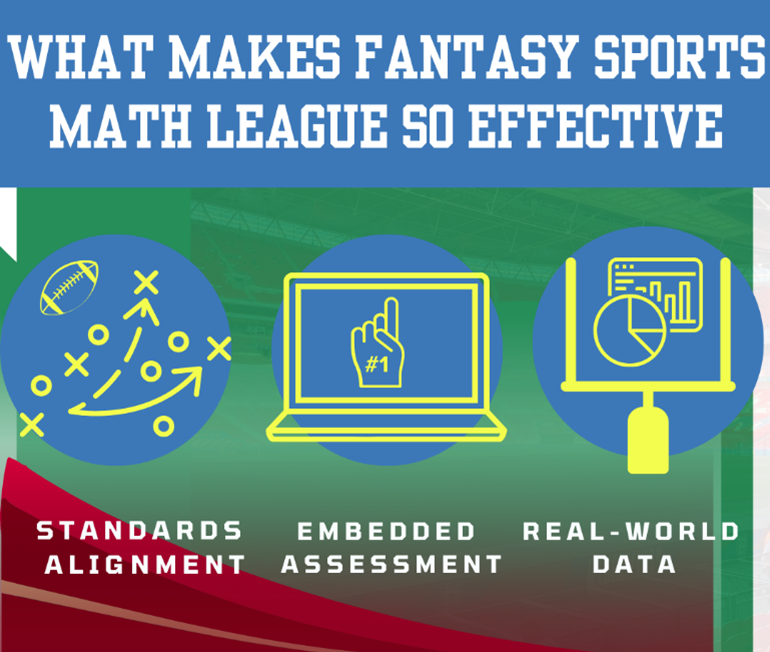
Standards Alignment
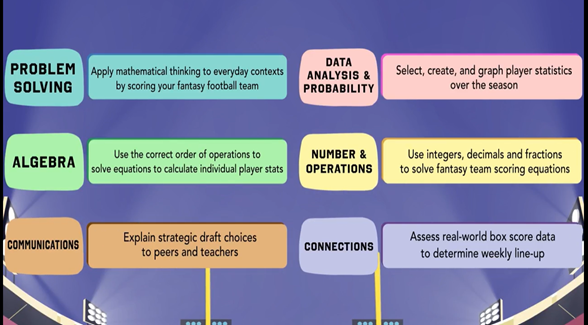
FSML is aligned to National Council of Teachers of Mathematics (NCTM) standards. Lesson plans identify the specific standards addressed by each activity, including:
1) Numbers and Operations: Fraction arithmetic, order of operations, integer operations
2) Algebra: Writing and evaluating expressions with variables, understanding functions
3) Data Analysis and Probability: Collecting, organizing, and interpreting sports data; creating graphs; making predictions
4) Problem Solving and Reasoning: Applying math to real-world contexts, communicating mathematical reasoning
FSML lesson plans also address Next Generation Science Standards (NGSS) science and engineering practices, including data analysis and computational thinking.
Platform Details
Grades: 5 - 9 (optimized for 6th grade)
Devices: Chromebooks, laptops, desktops (not tablets or mobile)
Compliance: COPPA compliant, FERPA compliant
Data: Real NFL game statistics, automatically updated weekly during the NFL season
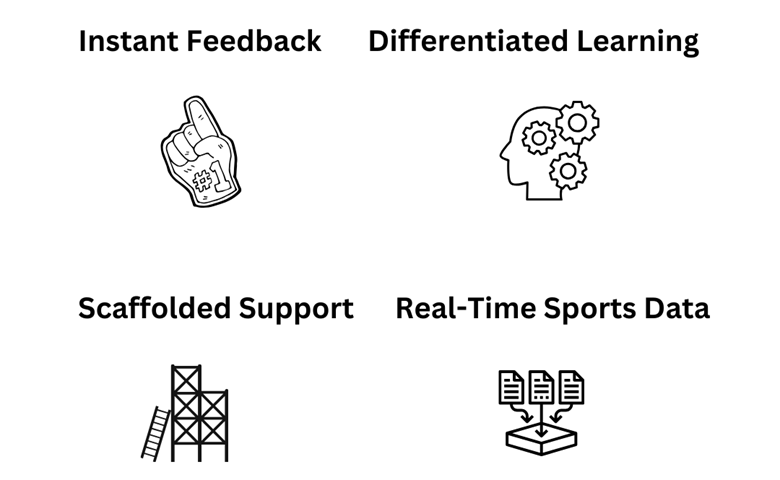
Teacher Tools: Teacher portal, real-time progress dashboards, lesson plans, slide decks, student worksheets, grading rubric, differentiated learning pathways
Season: Mid-August through the following July
Developer: STEMPlay Labs, powered by dfusion Inc.
Funding: U.S. Department of Education SBIR program, Contract #91990024C0024